Why I connect decision making theories with painting
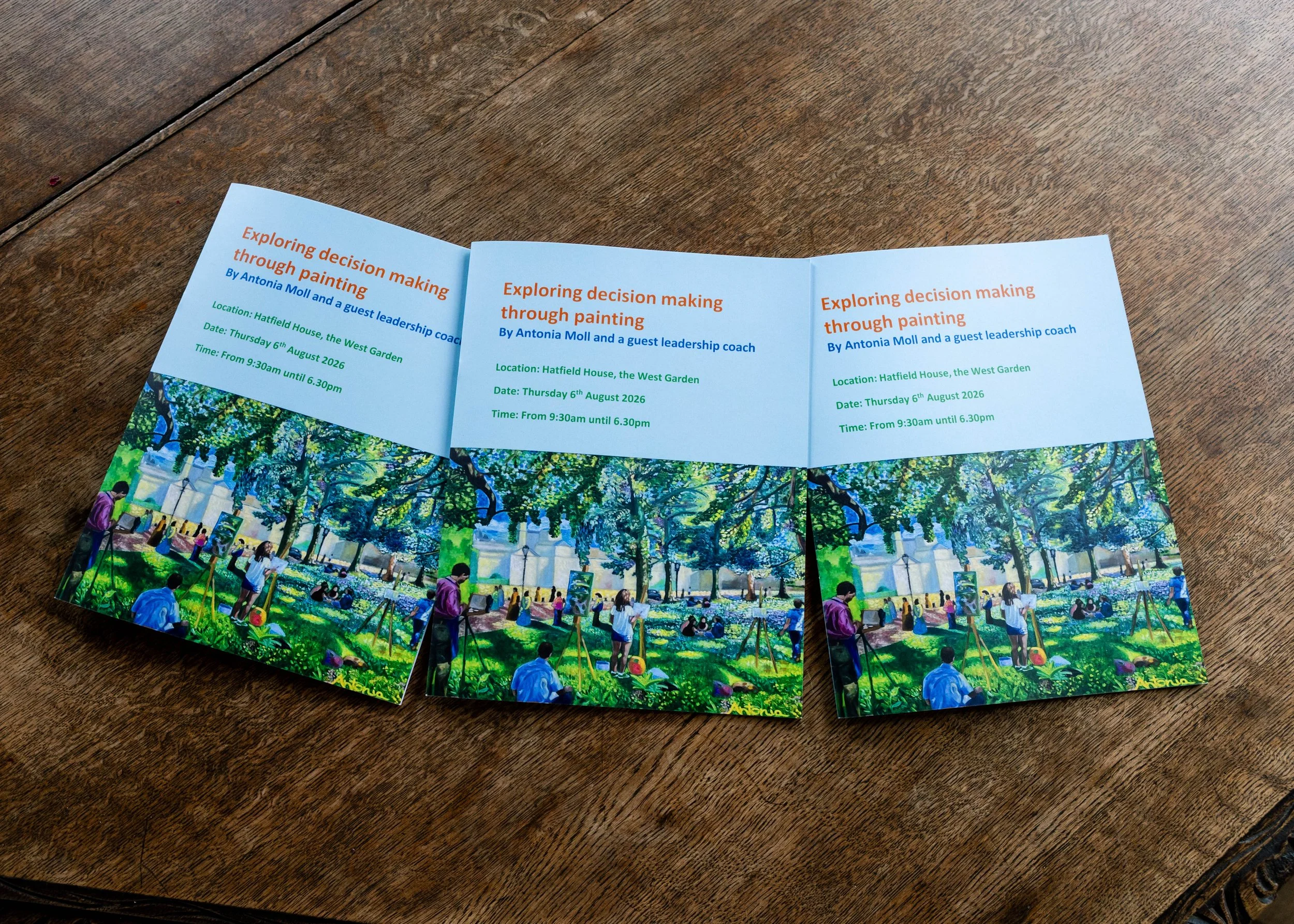
I recently created a workshop format for business professionals to get them to start painting with oil colours by connecting painting with decision making theories.
This type of workshop works well for team events and offsite and networking events between business professionals from different industries.
Why did I create this type of workshop?
The primary reason is that since I adopted a regular painting practice, I became more self-aware of how I approach every day and difficult decisions in my life. My painting practice gave me the confidence to take more risks, to be more patient when tackling long term problems and to reflect on how I approach both small decisions and difficult problems.
How did the workshop schedule work?
The workshop started with an introduction to decision making theories and oil painting. Each participant was given a booklet that included an introduction to the workshop, decision making theories and a list of questions as to how to start tackling a blank canvas.
The booklet included three key questions:
1. What do you find challenging when making decisions?
2. What do you want to achieve or learn today?
3. What do you think is your default decision making style?
…and one reminder: For today there is no right and wrong approach.
Afterwards each participant was given oil painting materials and a blank canvas. What to paint and how to paint it was their decision and problem to solve. I was available to provide support about how to start using oil painting materials and to understand painting techniques.
The day concluded with a discussion session and by revisiting the above questions. The aim was not to complete a successful painting but to become more self-aware about the painting process itself.
How does painting connect to decision making theories?
Broadly speaking there are three ways to approach a blank canvas (possibly many more):
1. The intuitive approach
2. The logical/ analytical approach
3. The unconscious approach
This is exactly how according to well-known decision making theories we tackle problems and every day decisions. Examples of authors and their decision making theories include the following:
Daniel Kahnemann’s two systems: System 1: Fast and Intuitive and System 2: Slow and Analytical.
Malcolm Gladwell’s analysis of the role of subconscious decision making in his book “Blink: The Power of Thinking without Thinking”: and his conclusion that “truly successful thinking relies on a balance between deliberate and instinctive thinking,”
Annie Duke’s thinking in bets and how good decisions can lead to bad outcomes.
Decisionscape: How thinking like an artist can improve your decision making (Elspeth Kirkam): four things artists do that can help your decision making processes: a. Distance and diminution; b. Viewpoint; c. Composition; d. Frame
Saying no to a decision is easier than saying yes. The “Hell Yes or No rule” (Derek Sivers): If you are not entirely enthusiastic about an opportunity, the default answer should be a hard no.
The workshop is designed to understand these theories in practice by tackling a blank canvas and to enable a discussion between participants.
What benefits does this type of painting workshop have for participants?
The key benefit is self-awareness and hopefully creating a passion for painting.
There seems today to be a misunderstanding that painting is purely expressive and easy. In fact, it is the opposite: to create a truly successful painting is one of the hardest problems to solve. It is like an elaborate puzzle that will be successful only when all elements balance and work together.
How to tackle such a difficult problem can teach us a lot about our ability to have good judgment and to tackle everyday problems. Several biases and outside factors will always play a role too. To become self-aware of both your own decision-making style and outside factors can create a useful tool for making better decisions in life and at work.
From the first workshop the following reflections were noted by participants in the discussion session:
Everyone started to paint immediately without hesitating. It showed that the group was good at starting, whether the first painting was bad or good didn’t matter.
Most decisions are reversible. If you start a painting the wrong way, you can scrape off the oil paint and start again. Often (not always) this applies to other decisions in life as well. The lesson here is clearly to take risks and start instead of procrastinating too long. At the same time thoughtful decisions are key to develop a successful painting.
It is not perfectionism that counts. Sometimes the most imperfect and intuitive brush strokes are the best.
A weekly “blank canvas” reset can help when making decisions and to clear the head.
If you are interested to learn more about my workshop format, please feel free to get in touch: antoniamoll@gmail.com
I am currently working with venues in Germany, Italy, France and the UK for enabling painting experiences through my business Terre Verte Painting. These locations can be used for offsite and team events too.